Dog Body Language Around Babies: The Signals Parents Miss
Reader-supported — if you buy through our links we may earn a commission, at no extra cost to you. As an Amazon Associate I earn from qualifying purchases. Details
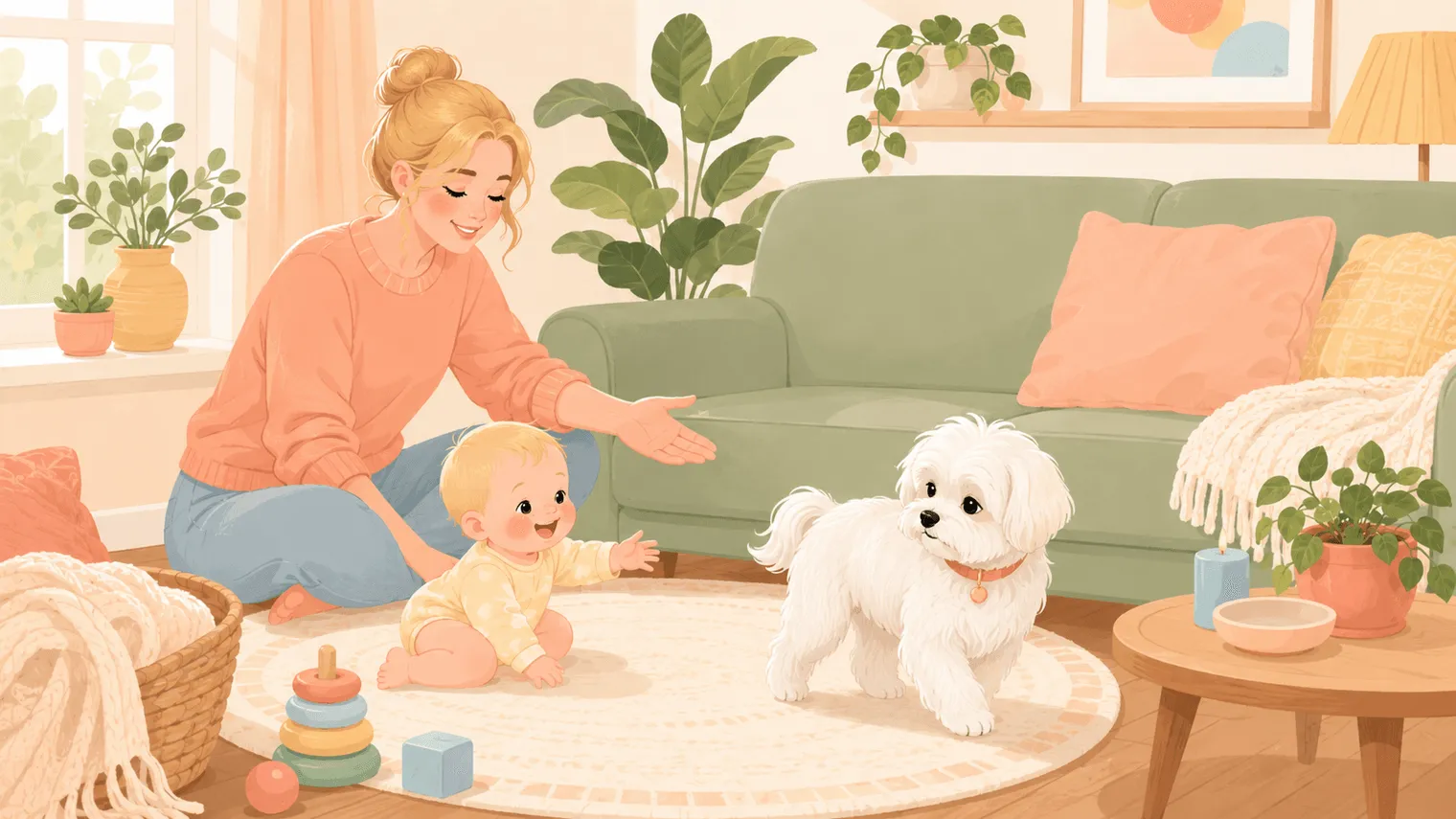
Here’s the sentence that should be printed on every crib: dogs rarely bite “out of nowhere.” They tend to broadcast discomfort first, often through subtle body-language warnings the people nearby don’t recognize — discomfort that usually builds gradually rather than appearing all at once. The good news: the language is learnable in an afternoon, and parents who speak it can answer their dog’s whispers so the dog never needs to shout.
This guide is played straight — no jokes in the safety-critical parts. It’s also general education, not a substitute for professional help with a dog already showing aggression. See the FAQ for when to call in a pro.
The whisper level: stress signals
These are the early, polite signals. One in isolation means little — dogs lick lips after dinner too. A cluster of them around the baby, or a pattern that repeats every time the baby is near, is your dog filing a formal request for help:
- Lip-licking and tongue flicks with no food in sight
- Yawning when nobody’s sleepy
- Turning the head or whole body away from the baby
- “Whale eye” — head turned away but eyes on the baby, showing the white crescent
- Sudden scratching or sniffing the floor — displacement behaviors, the canine equivalent of busying yourself with your phone
- Shaking off when not wet — a stress reset
- Ears pinned, weight shifted back, tail tucked or low
What to do at this level: create distance, cheerfully. Call the dog away, reward it, give it something better to do. Done consistently, this teaches the most valuable lesson available: when I’m uncomfortable, my human handles it.
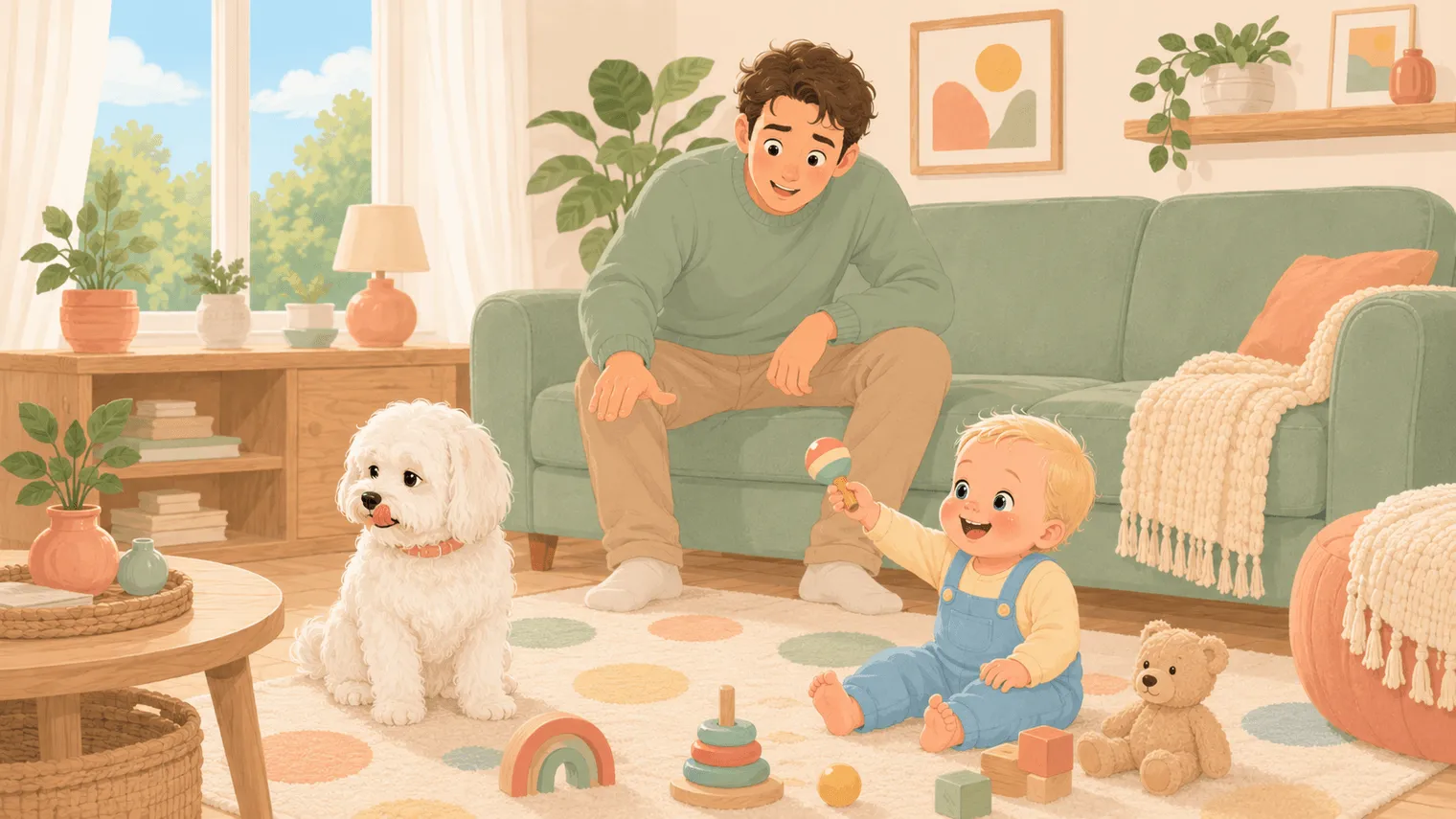
The spoken level: clear discomfort
If whispers go unanswered, dogs speak up:
- Freezing — sudden stillness, often with a closed mouth, is one of the most under-rated red flags in the vocabulary
- Hard stare at the baby
- Growling
About growling, the most misunderstood word in the language: never punish a growl. A growl is the smoke alarm, not the fire — it’s the dog choosing communication over action, and it deserves a calm response, not a battery removal. As the American Veterinary Society of Animal Behavior warns, using force to stop fearful reactions can suppress the outward signs — the growl, the threat display — so the dog may later act with fewer warnings, or none. Hear a growl around the baby: add distance now, manage the environment, and book the professional consult.
What “fine” actually looks like
For calibration, the green-light dog around a baby: loose, curvy body; soft eyes; mouth slightly open; weight even; able to disengage and go flop somewhere. The gold standard is the dog who finds the baby mildly boring — that dog isn’t suppressing anything. It genuinely has no problem, which is exactly what the first two weeks are designed to produce.
Five family rules that prevent the test
Most real-world incidents happen in a handful of predictable scripts, so ban the scripts:
- No unsupervised togetherness, ever. Lifeguard rule, for years; the AVMA’s guidance is the same — never leave a baby or small child alone with a dog. Gates make this livable.
- The dog’s bed, crate, and bowl are embassy soil. Once the baby is mobile, no crawling visits — manage the floor plan so the dog’s retreat is genuinely baby-proof.
- No hugging tests. Many dogs dislike hugs; toddlers love them. A peer-reviewed review of child–dog bite research notes that young children often hug dogs as a sign of friendship without realizing the gesture can intimidate a dog and induce fear or distress — a mismatch that’s almost entirely preventable by adults.
- Sleeping dogs stay unsurprised. “Let sleeping dogs lie” earned its proverb status the hard way.
- Food time is alone time. Dog eats behind a gate or in a crate — no small hands near bowls or long-lasting chews.
A dog whose whispers get answered, whose den is respected, and whose routine survives the baby is a dog that never needs page-two of this vocabulary. That’s the whole goal: a conversation so boring it never makes the news.
Questions families actually ask
My dog licks the baby constantly. Affection or stress?
Could be either, which is why context matters. Slow, relaxed licking with loose body language is usually social. But lip-licking with no baby contact, repeated tongue flicks, or licking that escalates when the baby fusses is often self-soothing — a stress valve. When in doubt, calmly increase distance and watch whether the dog relaxes.
Is a wagging tail always a good sign?
No — the tail is a volume knob, not a mood ring. Loose, sweeping, mid-height wags usually mean relaxed. A high, stiff, fast wag is arousal, which can tip either way; a low, slow wag with a still body can signal uncertainty. Read the whole dog: a wagging tail on a stiff body is not a happy dog.
What should I do the moment I see stress signals?
Add distance, calmly and without drama. Call the dog to you (happy voice), reward the recall, and give it a job away from the baby — a mat, a chew, a different room with something good. You're not punishing; you're answering the dog's politely-worded request before it has to ask louder.
When is it time to call a professional?
Immediately if you see growling, snapping, stiff freezing, or hard staring directed at the baby — or guarding behavior around the baby’s things. Look for a certified behaviorist (CAAB or DACVB) or a credentialed trainer experienced with kids. Early help is cheap insurance; this is the one area of dog ownership where waiting to see is the wrong move.